How to scrape TikTok search results: A complete guide for 2026

TikTok has transformed from a simple video-sharing app into a global cultural engine. With over 1 billion active users, the platform dictates what we listen to, what we buy, and how we communicate. For businesses, marketers, and researchers, TikTok is not just entertainment; it is a repository of real-time consumer sentiment and trend data.
However, getting that data is a top challenge as TikTok employs some of the most sophisticated anti-scraping technologies in the world. In this article, we will explore why TikTok data is essential, the technical barriers to getting it, and how you can use the TikTok Search Scraper to automate your data collection at scale.

How to scrape TikTok search results: A complete guide for 2026
The importance of TikTok data in modern marketing
In the past, brands relied on slow-moving market research surveys. Today, they rely on TikTok in 2026 as a primary growth engine, utilizing authentic, low-polish content, behind-the-scenes storytelling, and trending sounds to drive viral engagement. With over 5 billion daily users, it is crucial for building brand loyalty and reaching audiences who spend a significant amount of time on social media. The speed at which a trend moves from a single video to a global phenomenon is unprecedented.
Trend tracking and cultural shifts
By scraping TikTok search results, you can identify emerging trends before they hit the mainstream. For example, a search for "sustainable fashion" might reveal specific local hashtags or challenges that are gaining momentum. Tracking these shifts allows you to adjust your content strategy in real-time, ensuring your brand remains relevant.
Audience behavior and sentiment analysis
Comments, view counts, and video descriptions provide insight into how users feel about specific topics. Analyzing these data points helps you understand the language your target audience uses, their pain points, and what kind of content they find engaging.
Competitor and influencer benchmarking
Who are the top creators in your niche? What music are they using? How often do they post? You can answer all these questions by scraping search results for relevant keywords. This data helps you benchmark your performance against competitors and identify potential influencers for future collaborations.
Key aspects of brand reliance on TikTok
-
Authenticity over production: Brands, particularly in fashion and beauty, succeed by using smartphone cameras to show raw "before and after" transformations rather than polished ads.
-
Driving growth: Small businesses in sectors like fashion, fintech, and beauty use TikTok as their primary marketing channel to reach new audiences.
-
Immersion & trends: Successful brands like Sandro Paris and Yahoo create immersive, trend-driven content to stay relevant in pop culture.
-
Massive reach & user-generated content (UGC): Major brands like ESPN hold millions of followers, while companies increasingly rely on UGC to build trust.
-
Strategic outsourcing: To keep up with the pace of trends, many companies outsource their TikTok creative to specialists
Why traditional scraping methods fail
If you have tried to build a simple Python script to scrape TikTok, you have likely encountered immediate blocks or endless captchas. TikTok's security infrastructure is designed to distinguish between automated bots and real human users.
Dynamic content and JavaScript heavy lifting
TikTok is a single-page application (SPA) that heavily relies on JavaScript to load content. A basic HTTP request will return an empty shell of a page. To get actual video data, you need a browser-based scraper that can render the DOM and handle infinite scrolling.
Advanced bot detection
TikTok checks for several technical signals to identify automation, among which include:
- Navigator.webdriver: Many automated browsers leave this flag set to
true, making them easy to spot. - Fingerprinting: Systems analyze your browser's font list, canvas rendering, and hardware identifiers to see if they match a standard device.
- Client Hints: Modern anti-bot systems check sec-ch-ua headers. If your User-Agent indicates that you are on Chrome 123 but your headers say something else, you will be blocked.
- Datacenter IP blocking: TikTok blocks entire IP ranges belonging to cloud providers (AWS, GCP, Apify, etc.) at the CDN level before your browser fingerprint is even evaluated. A request arriving from a datacenter IP receives an empty page shell regardless of how convincing the browser looks.
The solution: TikTok Search Scraper
The TikTok Search Scraper is a professional-grade Apify Actor designed to bypass these barriers. It does not just "read" the page; it interacts with it as a human would.
Key features for maximum resilience
- Human-like behavior: The scraper mimics real user interaction. It does not just jump to the bottom of the page; it performs smooth, variable-speed scrolling. It even "pauses" to simulate a user watching a video, which significantly reduces the risk of triggering behavioral blocks.
- Browser profile rotation: Every run can use a different browser profile. These profiles include curated User-Agents, realistic viewports, and synchronized Client Hints. This makes each request appear to be coming from a unique, legitimate device.
- Stealth technology: By leveraging the stealth plugin, the Actor masks its automated nature, overriding the
navigator.webdriverproperty and other common detection vectors. - Deep fingerprint evasion: Beyond the stealth plugin, each session generates a Bayesian browser fingerprint (canvas noise, WebGL vendor/renderer, AudioContext noise, WebRTC IP leak prevention) that is unique per run and consistent with the selected browser profile.
- Session cookie injection: You can supply real cookies exported from your own browser directly into the actor's input. TikTok's scoring system grants significantly higher trust to sessions that arrive with authentic tokens like
msTokenandttwid— the same ones a real browser accumulates after visiting TikTok normally. - Custom proxy URL: Instead of purchasing residential proxies, you can route the actor's traffic through your own machine. This makes TikTok see your home IP address rather than a cloud datacenter IP, which is often the single most effective unblock technique.
- Automatic cookie persistence: After every successful run, the actor saves the live TikTok session cookies to Apify's storage. The next run automatically reloads them, so the session trust level builds up over time without any manual action.
- Rehydration script fallback: TikTok stores its initial data in a JSON blob called a rehydration script. If the DOM structure changes or is temporarily hidden, the Actor can pull data directly from this script, ensuring high reliability even during platform updates.
Scraping TikTok without residential proxies
Residential proxies work reliably, but they come at a cost. The TikTok Search Scraper now includes two built-in techniques that let you bypass TikTok's datacenter block without purchasing a residential proxy plan.
Technique 1: Session cookie injection
When you browse TikTok in your regular Chrome or Firefox browser, TikTok sets a collection of session cookies on your machine — most importantly msToken, ttwid, and s_v_web_id. These tokens tell TikTok that the request is coming from a real, established browser session. When you inject them into the actor, TikTok extends that same trust to the automated run.
How to export your cookies:
- Install the free Cookie-Editor extension for Chrome or Firefox.
- Open https://www.tiktok.com and browse normally for about 30 seconds — scroll the feed, watch a video.
- Click the Cookie-Editor icon in your browser toolbar.
- Click Export → Export as JSON.
- Copy the entire JSON array that appears.
- Paste it into the Session Cookies field in the actor's input on Apify.
The actor normalizes the cookie format automatically, strips any extension-specific metadata, and injects the cookies before any request is sent. It also skips the homepage warm-up visit so that the higher-trust tokens you provided are not overwritten by datacenter-seeded ones.
Note: Cookies expire — typically within a few hours to a few days. If scraping stops returning results, re-export and update the field. The actor's automatic cookie persistence feature saves live cookies from each successful run, so subsequent runs start with increasingly fresh tokens even without a manual re-export.
Technique 2: Route traffic through your own machine
If you want every actor run to use your home IP address, you can run a lightweight SOCKS5 proxy on your local machine and expose it to the internet using a free tunneling service. The actor sends all its traffic through your tunnel, so TikTok sees your residential IP — the same one that works when you run the scraper locally.
Setup with microsocks and ngrok (free tier):
# Step 1 — Install and start a local SOCKS5 proxy
# macOS/Linux:
brew install microsocks   # or: sudo apt install microsocks
microsocks -p 1080

# Step 2 — Create a public TCP tunnel to your proxy
# (requires a free ngrok account at https://ngrok.com)
ngrok tcp 1080
# ngrok will print something like: tcp://0.tcp.ngrok.io:12345 → localhost:1080

# Step 3 — Paste the address into the actor's "Custom Proxy URL" field:
# socks5://0.tcp.ngrok.io:12345
Your machine must stay running and connected while the actor is active. The customProxyUrl field takes priority over the Proxy Configuration panel, so you do not need to configure anything else.
Tip: Combining both techniques — injecting real session cookies and routing through your home IP — gives the actor the best possible chance of success. TikTok sees a request from a known residential IP carrying an established session, which is indistinguishable from a real user.
What data can you extract?
The TikTok Search Scraper provides a comprehensive set of data points for every video result:
| Field | Description |
|---|---|
| Video ID | The unique identifier for the video (id). |
| Video URL | The direct link to the TikTok video (url). |
| Description | The full caption, including hashtags and mentions (description). |
| View Count | The number of times the video has been played (views). |
| Likes | The number of likes the video has received (likes). |
| Comments | The number of comments on the video (comments). |
| Shares | The number of times the video has been shared (shares). |
| Author Info | Username (uniqueId), nickname, avatar URL, verification status (verified), and followers count (author). |
| Music Title | The song or sound used in the video (music). |
| Music Author | The creator of the music or sound used in the video (musicAuthor). |
| Hashtags | A list of hashtags included in the video (hashtags). |
| Duration | The length or duration of the video (duration). |
| Timestamp | The date and time the video was published (timestamp). |
| Scraped At | The exact date and time the data was extracted (scrapedAt). |
| Source | The method or source used to extract the data (source). |
How to use the scraper
Here is a sample of the extracted JSON output:
 {
    "id": "7580436439..........",
    "url": "https://www.tiktok.com/@techuser112/video/7580436439..........",
    "description": "Comment \"tech\" if you want a road map on how to get into any of these careers",
    "views": "11K",
    "likes": "",
    "comments": "",
    "shares": "",
    "author": {
      "uniqueId": "techuser112",
      "nickname": "tech with Lesedi’s profile",
      "avatar": "https://p16-sign-sg.tiktokcdn.com/tos-alisg-avt-0068/9f813384bac2a.......",
      "verified": false,
      "followers": ""
 },
    "music": "Lesedi with Adrian’s 7AM - Slowed + Reverb",
    "musicAuthor": "",
    "hashtags": ["technology", "techjobs", "techreview", "techroadmap"],
    "duration": "2025-12-5",
    "timestamp": "",
    "scrapedAt": "2026-03-21T10:47:10.773Z",
    "source": "dom"
 }
How to use the scraper on the Apify platform
Running the TikTok Search Scraper on the Apify platform is a simple four-step process. You do not need any coding knowledge to get started.
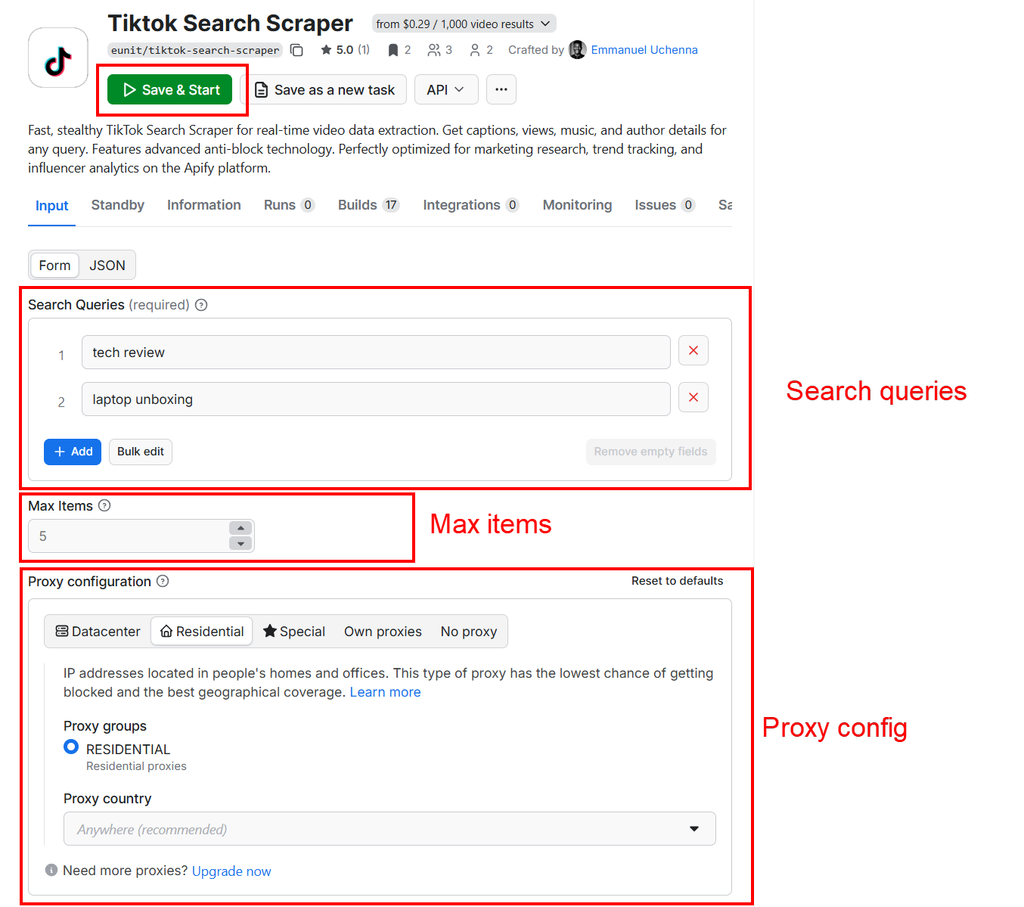
Step 1: Set your queries
Once you are on the TikTok Search Scraper page, navigate to the Input tab. In the Search Queries field, enter an array of search terms you want to analyze. For example: ["tech review", "laptop unboxing", "coding tips"]. This screenshot below shows what you need to get started:
Tiktok Search Scraper
Step 2: Define your limits
Use the maxItems field to specify how many videos you want to collect per query. If you are conducting a deep dive, consider setting this to 500. For a quick pulse check, 20 results might be enough.
Step 3: Configure proxy settings
TikTok has strict regional and IP-based limits. To avoid being blocked, always use Apify Proxy. We highly recommend using Residential proxies, as they use IP addresses assigned to real households, making your scraping activity indistinguishable from regular traffic. Learn more about ApifyProxy from the Apify documentation.
Running without residential proxies: If you prefer not to purchase a proxy plan right now, the actor provides two alternative bypass options under the Advanced — Datacenter IP Bypass section of the input:
- Session Cookies — Paste a JSON cookie array exported from your real browser (see Technique 1 above). The actor injects these before any request, causing TikTok to treat the session as a real, trusted browser.
- Custom Proxy URL — Enter a
socks5://orhttp://URL pointing to a proxy running on your own machine (see Technique 2 above). This makes TikTok see your residential IP.
Using both options together offers the highest success rate without any proxy subscription.
Step 4: Run and export
Click the Start button at the bottom of the screen. You can monitor the progress in the Log tab. Once the run is finished, go to the Storage tab to export your data. You can choose from several formats, e.g., JSON, CSV, Excel, or XML.

Save and Start the TickTok Search Scraper
Optimization and cost efficiency with Pay-Per-Event
Many scrapers charge based on the computing power they consume, which can be unpredictable and vary significantly. The TikTok Search Scraper uses a more transparent model: Pay-Per-Event (PPE).
With PPE, you are charged a fixed price of $0.29 for every 1,000 video results. This means:
- You only pay for the data you actually get.
- Your costs are perfectly predictable.
- You do not pay for the platform's overhead or idle time.
Use cases: Putting the data to work
Influencer marketing
Agencies use the scraper to find rising stars. By searching for niche keywords, they can identify creators who have high engagement but have not yet been "discovered" by major brands.
Market research
Pharma and retail companies scrape TikTok to see how people are using their products. Are they finding new use cases? Are they complaining about a specific feature? This qualitative data is often more honest than what you get in a focus group.
Trend capitalization
Media companies track trending hashtags to decide what topics to cover next. By seeing which videos are gaining the most views in a short period, they can jump on trends while they are still hot.
For Developer: Automate with JavaScript
If you are a developer looking to integrate the TikTok Search Scraper directly into your projects, you can use the official Apify API JavaScript/TypeScript client.
Installation
First, install the apify-client package in your project:
npm install apify-client
Usage Example
To get started, initialize the client with your Apify API token and pass your search queries. Here is an example script showing how to scrape data for the "AI coding" query:
import { ApifyClient } from 'apify-client';

// Initialize the ApifyClient with your Apify API token
// Replace the '<YOUR_API_TOKEN>' with your token
const client = new ApifyClient({
 token: '<YOUR_API_TOKEN>',
});

// Prepare Actor input
const input = {
    "queries": [
        "AI coding"
    ],
    "maxItems": 5,
    "proxyConfiguration": {
        "useApifyProxy": true,
        "apifyProxyGroups": [
            "RESIDENTIAL"
        ]
    },
    // Optional: paste your browser cookies to bypass datacenter IP blocks for free.
    // Export from Cookie-Editor extension (Export as JSON), then paste the array here.
    // "sessionCookies": "[{\"name\":\"msToken\",\"value\":\"...\",\"domain\":\".tiktok.com\",...}]",

    // Optional: route traffic through your own machine instead of Apify's datacenter.
    // Run a local SOCKS5 proxy (e.g. microsocks -p 1080) and expose it with: ngrok tcp 1080
    // "customProxyUrl": "socks5://0.tcp.ngrok.io:12345",
};

// Run the Actor and wait for it to finish
const run = await client.actor("eunit/tiktok-search-scraper").call(input);

// Fetch and print Actor results from the run's dataset (if any)
console.log('Results from dataset');
console.log(`💾 Check your data here: https://console.apify.com/storage/datasets/${run.defaultDatasetId}`);

const { items } = await client.dataset(run.defaultDatasetId).listItems();
items.forEach((item) => {
 console.dir(item);
});

// 📚 Want to learn more 📖? Go to → https://docs.apify.com/api/client/js/docs
Legal and ethical considerations
When scraping TikTok, it is important to act responsibly.
- Respect privacy: Only scrape publicly available data. Never attempt to access private accounts or unauthorized sections of the platform.
- Avoid overloading: Use the scraper's built-in delays and human-like interactions to avoid putting unnecessary strain on TikTok's servers.
- Comply with regulations: Ensure your use of the data complies with local regulations, such as GDPR in the EU or CCPA in California.
Wrapping Up
TikTok is a powerful source of real-time intelligence, but accessing it requires a professional approach. The TikTok Search Scraper on the Apify platform provides the stealth, speed, and reliability you need to turn raw social media activity into actionable business insights.
Start your first run today and stop guessing about the latest trends.
Happy automating!

Emmanuel Uchenna
@eunit99Hi, I’m Emmanuel Uchenna — a frontend engineer, technical writer, and digital health advocate passionate about building technology that empowers people. With over five years of experience, I specialize in crafting clean, scalable user interfaces with React, Next.js, and modern web tooling, while also translating complex technical ideas into clear, engaging content through articles, documentation, and whitepapers.